
Sydney’s Hyatt Regency Hotel was buzzing in early November for the sold‑out 2025 Diabetes Feet Australia (DFA) Conference - and Foot Balance Technology (FBT) was there to share what works in the real world. In this blog, you’ll learn how our team links culture, climate and belief to better footwear adherence; how data can reduce trial‑and‑error in offloading; and how AI can make ulcer assessment more consistent. More than a conference recap, it’s a window into how FBT turns research into everyday care.
At FBT, our mission is to prevent avoidable complications by uniting rigorous pedorthic science with compassionate, culturally aware care. We co‑design footwear and orthoses with patients, test devices in various settings - and when it helps, use monitoring to understand adherence patterns. Our research mirrors that loop: behaviour and adherence, evidence‑based offloading powered by structured data, and digital tools for faster, reliable assessment. That clinic‑to‑research‑to‑clinic cycle shaped our three major presentations at the DFA Conference from our Founder, Dr Sayed Ahmed, Dr Martin Nguyen and Professor Ashad Kabir.
Beyond fit: culture, climate and belief in adherence
(Dr Sayed Ahmed)
At the heart of our presence was our Founder, Dr Sayed Ahmed’s Rapid Fire session presentation, “Beyond Fit and Offloading: Culture, Climate & Belief in Diabetic Footwear Adherence.” Dr Ahmed began with a clear truth: “Adherence is low, especially in indoor settings.” Our clinic monitoring and research echo this, showing a big difference in the use of diabetic footwear internally as opposed to externally. Acknowledging his PhD supervisors, Professor Susan Nancarrow and Dr Alex Barwick, and his mentor in pedorthics, Mr Karl-Heinz Schott, Sayed always goes to great lengths to pay tribute to those who played such vital roles in his journey to becoming Australia’s first PhD in Pedorthics.
Why do people take off the very shoes that protect them? Culture, religion, identity and climate all play a part. “In a lot of cultures including my own (Asian), we don’t wear outdoor shoes indoors,” Sayed points out. On social visits, “if you don’t leave them at the door your hosts will look at your shoes rather than your face!” A practical fix is to carry a clean, indoor pair and explain the medical need. In places of worship such as mosques and temples - where footwear is forbidden or restricted - plans must be respectful, tailored and co‑designed.
Self‑image matters too. Some patients fear appearing “different,” whether in a waiting room or at dinner, or worry if their footwear will “match” a partner’s outfit. Family opinions can support or undermine confidence. Workplaces add complexity: safety boots may be mandatory on sites, while many businesses still expect corporate dress, including high heels for women.
Climate completes the picture. In hot, humid regions, thermal comfort and breathable materials are essential so shoes stay on at home and outdoors. Sayed also shared instances where faith practices intersect with biomechanics: a Muslim patient with a hallux issue reduced strain by adapting prayer posture; a Hindu patient benefited from similar, respectful adjustments.
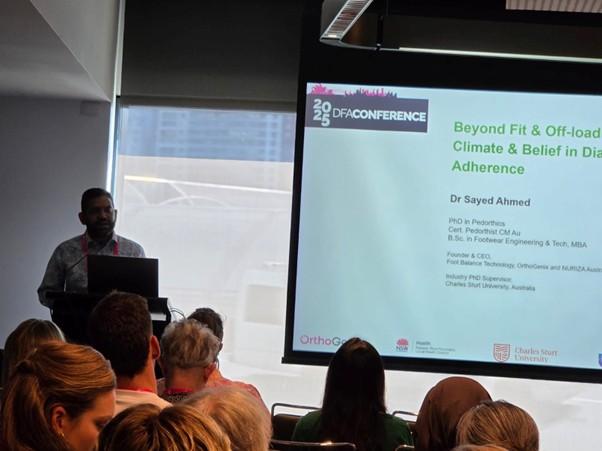
His core message: pair sound biomechanics with cultural literacy, family engagement and climate‑aware design. Listen first, then co‑design solutions people will actually wear - every day, in every setting
A data‑driven path to better offloading prescriptions
(Research Podiatrist Martin Nguyen)
Martin Nguyen explained that the FBT research team has taken a fresh, practical approach to offloading: learn from what’s already working. We looked back at people who had a history of plantar ulcers under the big toe or lesser toes and then stayed ulcer‑free while using prescribed footwear and orthoses. By studying these successful cases, our team spotted patterns that make prescriptions more likely to work - things like matching footwear type to foot shape, using the right rocker profile and combining smart insole tweaks for the big toe and forefoot.
Instead of relying on trial‑and‑error, FBT’s aim is to turn these patterns into a simple clinical decision support tool - think of it as a clear checklist that helps clinicians choose the right shoe, rocker and insole modifications for each person. The next step is to test these rules across more clinics and build them into easy‑to‑use software so busy teams can personalise offloading faster.
AI that standardises ulcer tissue assessment
(Professor Ashad Kabir)
Professor Kabir’s talk focused on a challenge every clinician knows: wound assessments can vary from person to person and take time. He explained that at FBT, we have created a carefully labelled photo library of diabetic foot ulcers and trained AI to recognise key tissue types - granulation, slough, maceration, necrosis, bone and tendon. The simple insight: when the AI sees the whole picture (not just tiny tiles), it makes more accurate calls and gets closer to expert judgement.
What does this mean in practice? Imagine opening a secure app, snapping a photo and getting an instant, consistent breakdown of the wound’s tissues to guide your next steps and track healing over time. The goal isn’t to replace clinicians - it’s to give them a reliable second opinion that saves time and standardises documentation.
What this means for Patients and Clinicians
The DFA Conference was a resounding success and a credit to Diabetes Feet Australia and everyone else involved. We’re proud that FBT’s mix of real‑world clinic insight and rigorous research resonated - and, more importantly, that it points to practical changes patients can feel. We are always looking for opportunities like the DFA Conference to share our knowledge across Australia and internationally. Dr Sayed Ahmed is regularly invited to address major foot health forums both locally and overseas, and our team continues to publish, teach and co‑design solutions with partners. If you’d like to work with us - or refer a patient - our doors are open.
Advancing Foot Health Together: FBT’s Contributions at the Sold‑Out DFA Conference